
When the Crowds Peak and How to Enjoy It
Short answer: Madinah’s busiest season runs from December to the end of Ramadan, which in 2027 is expected around 8 March. Masjid Al Nabawi had 21,615,977 visitors in September 2026 alone, and that’s one of the quieter months. To enjoy it, book the Rawdah early on Nusuk, stay within walking distance, move between prayers rather than at them, and eat at off-peak times.
The first time you see it, it stops you. Rows of worshippers stretching past the umbrellas and out into the courtyards. Shoes lined up by the thousand. The low hum of a hundred languages at once, and then complete silence when the iqamah starts.
It’s beautiful. It can also be a lot, especially with tired kids, an older parent, or a body that’s already done two flights and a bus ride. This guide is about holding on to the beautiful part. We’re Furni, a small café four minutes’ walk from Masjid Al Nabawi, open around the clock except during salah. So we see Madinah’s busy months from behind the counter, every day.
How busy does Masjid Al Nabawi get?
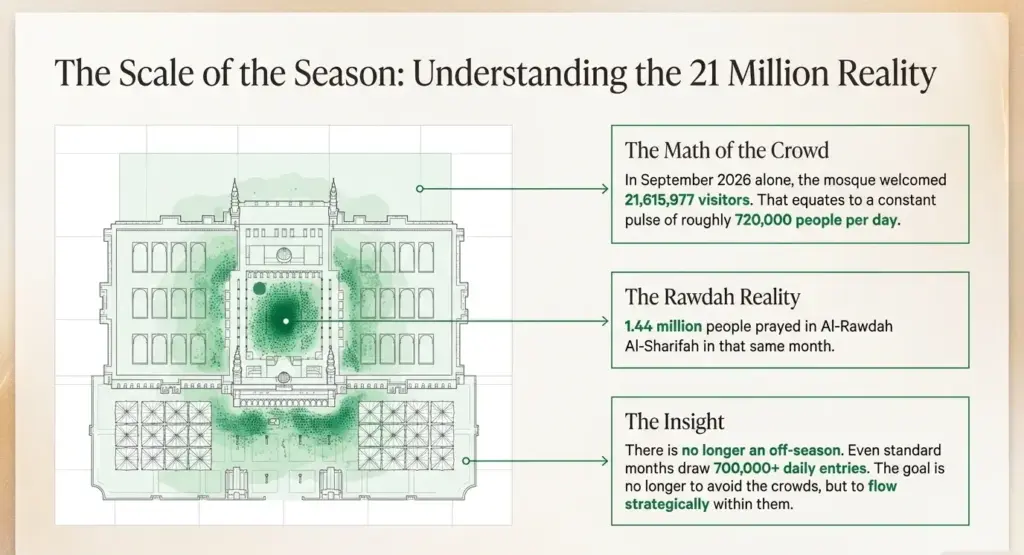
Very. The General Authority for the Care of the Two Holy Mosques publishes monthly figures, and for September 2026, as reported in October 2026, they were:
- 21,615,977 visitors to Masjid Al Nabawi
- 2,124,421 people who greeted the Prophet (peace be upon him) and his two companions
- 1,449,791 who prayed in Al-Rawdah Al-Sharifah
- 79,599 older people and people with disabilities given help by the mosque’s teams
Divide 21.6 million by 30 and you get roughly 720,000 visits a day. In a month nobody calls peak season.
The busy months go higher. A December 2025 report in Riyadh Daily put attendance at more than 23 million during Jumada al-Akhirah 1447. And Ramadan is another level again: official figures collected by medina.city show 10,789,467 prayer entries in just the first ten days of Ramadan 1447. That’s over a million a day.
Here’s what we take from those numbers. There isn’t really an “off season” in Madinah any more. There’s busy, and there’s busier.
When is Madinah busiest? The 2026–27 calendar
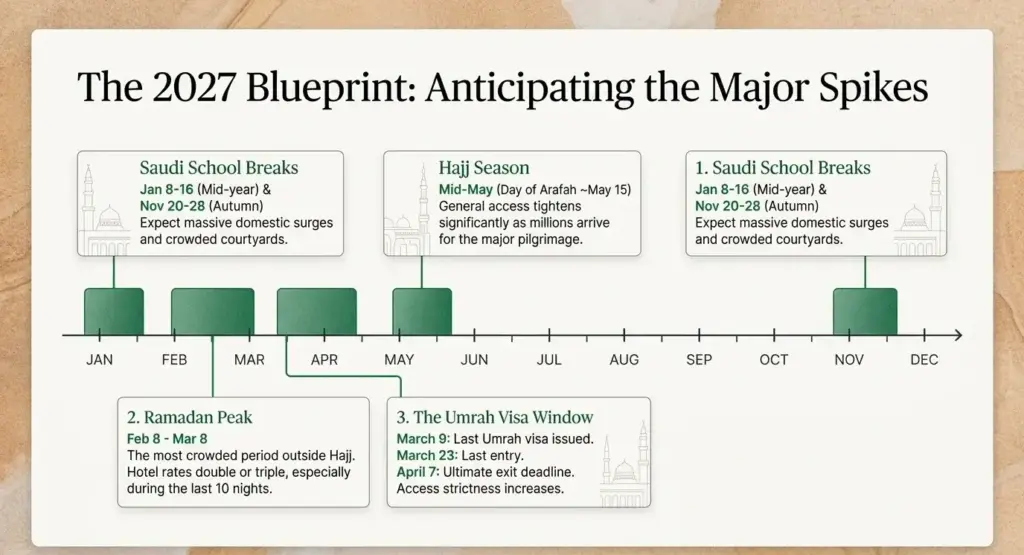
Crowds in Madinah follow the Islamic calendar more than the weather, so peak season moves about 11 days earlier each year. Here’s how the next few months are expected to look. Islamic dates depend on moon sighting, so treat every date below as approximate.
| Period | Expected dates | Crowds | What to know |
|---|---|---|---|
| Late November | Now to end of November 2026 | Busy, building | Pleasant days (about 30°C highs). November is one of the wetter months, so storms are possible. |
| Rajab and Sha’ban 1448 | Around 10 December 2026 to 7 February 2027 | Very busy | Many families travel before Ramadan. Winter school holidays add to it. January is the coolest month and usually the dearest for hotels. |
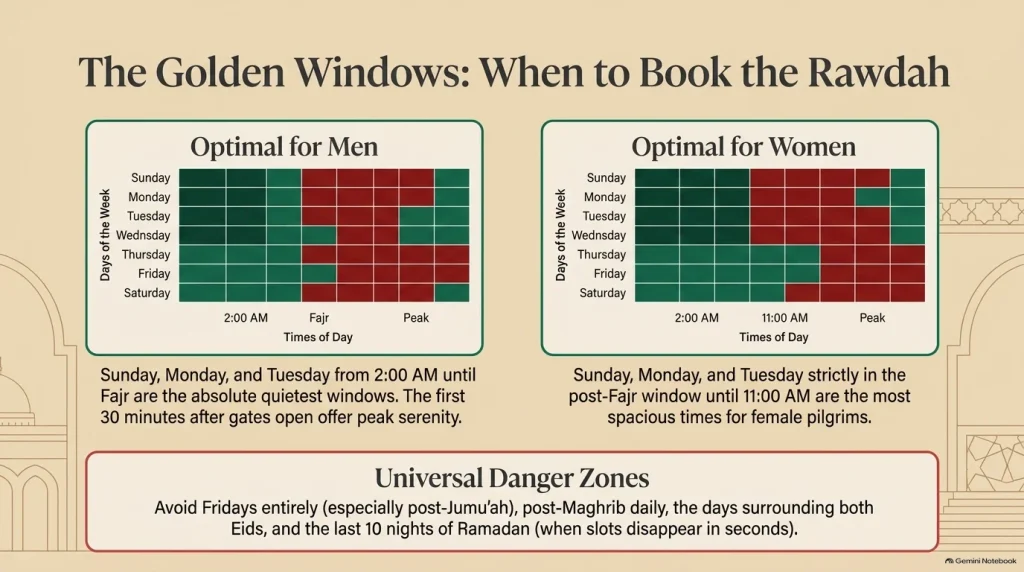
| Ramadan 1448 | Around 8 February to 8 March 2027 | Peak, especially the last ten nights | Over a million prayer entries a day last Ramadan. Hotels near the Haram cost far more. |
| Eid and the end of Umrah season | Eid around 9 March 2027 | Busy, then easing | Last Umrah visas are expected to be issued on 9 March, last entry 23 March, and departure by 7 April 2027. |
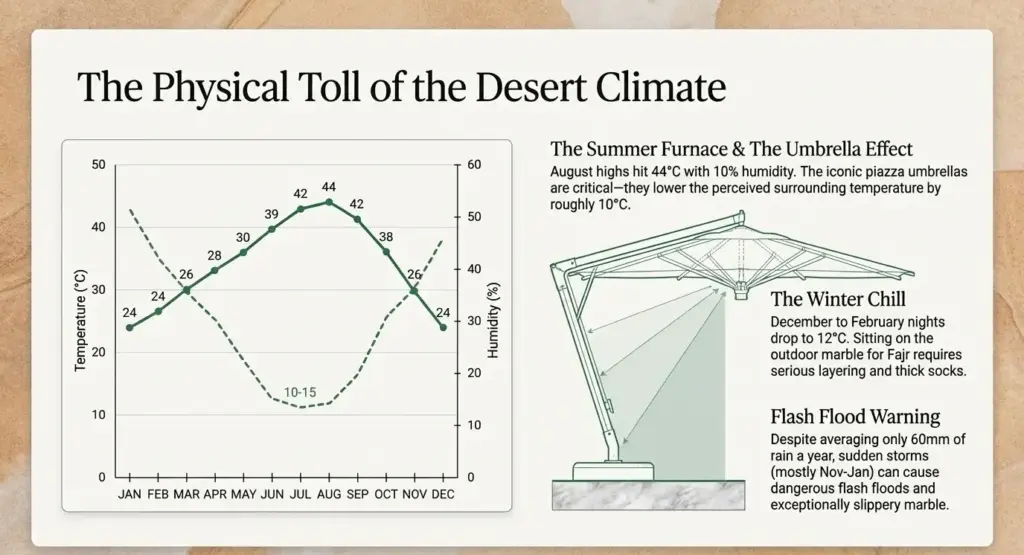
| Summer | June to September | Busy, but the quietest stretch | Highs of 43–44°C. Cheapest hotels of the year. |
The 1448 Umrah deadlines come from the Ministry of Hajj and Umrah’s season calendar, summarised by ZiyaraGo in November 2026. Always confirm them in Nusuk before you book. Our guide to Umrah dates in Rajab, Sha’ban and Ramadan 1448 goes through each one.
Two things also push numbers up whatever the month. Fridays, when Jumu’ah brings in worshippers from across the city. And school holidays, both in Saudi Arabia and in countries that send large numbers of pilgrims, such as the UK’s winter and spring breaks.
What’s the best time to visit Madinah if you want fewer crowds?
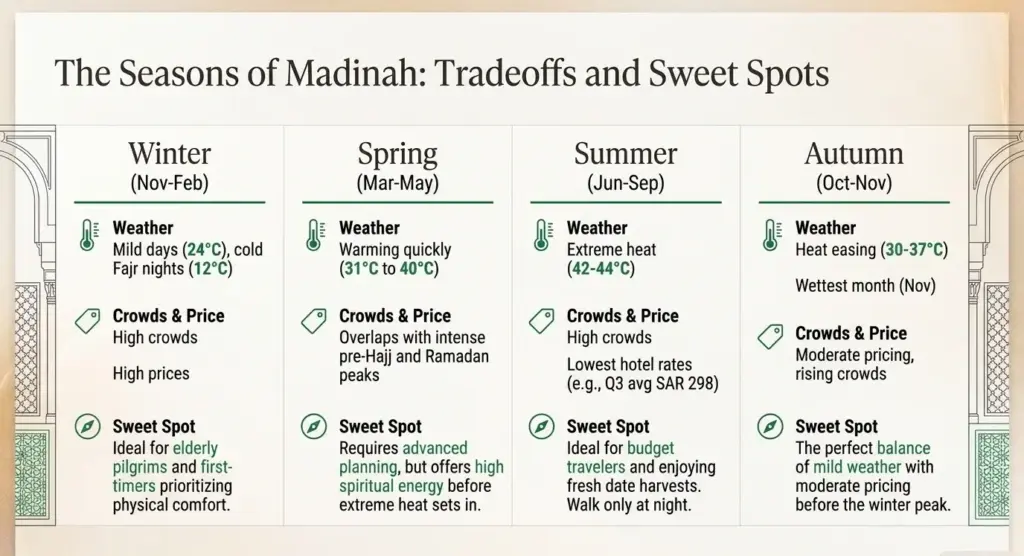
If calm matters more than cool weather, go in summer or early autumn. If cool weather matters more, accept the crowds and come in winter. There isn’t a month that gives you both, and we’d rather tell you that straight.
Here’s how the trade-off looks in real numbers:
- Weather. The 1991–2020 averages, as listed by medina.city, give January highs of 24°C and lows of 12°C. August averages 44°C. That’s not a typo.
- Hotel prices. Wego data for the 12 months to August 2026, reported by ZiyaraGo, had Madinah’s cheapest nights in September (about US$127) and its dearest in January (about US$266). Roughly double.
- How full the city is. Madinah led Saudi Arabia for hotel occupancy in the first quarter of 2026, at 82%, with an average daily rate of SAR 453, according to Ministry of Tourism data reported by Ajel in July 2026.
So who should go when? For most families with older parents, we think October to mid-November is the sweet spot: the worst heat has gone, the pre-Ramadan rush hasn’t started, and prices haven’t climbed. If you’re young, healthy and on a tight budget, summer works, as long as you live by night and rest through the middle of the day. And if Ramadan in Madinah is the whole point of your trip, go. Just go knowing what it’ll be like, and book early.
How to enjoy Madinah when it’s packed: 8 tips
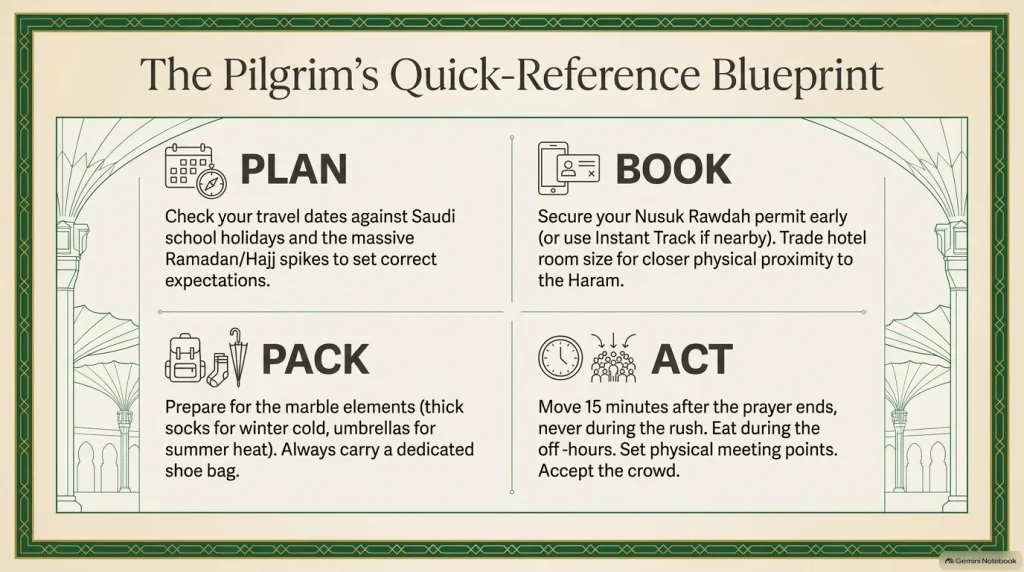
1. Book the Rawdah the moment you can
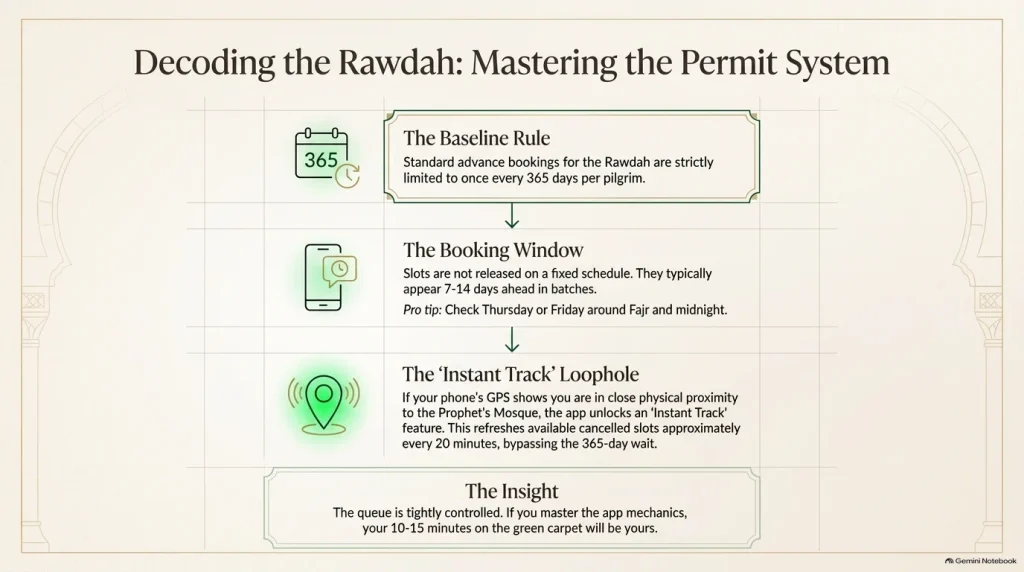
The Rawdah is where slots are most precious. You need a permit through the Nusuk app, and as reported in December 2025, booking is allowed once every 365 days, with an instant option for people already near the mosque. Men and women have separate time slots. Arrive 15 to 30 minutes early with your QR code ready, and expect around 10 to 15 minutes inside. Knowing that in advance helps. You won’t spend your few minutes worrying about the clock.
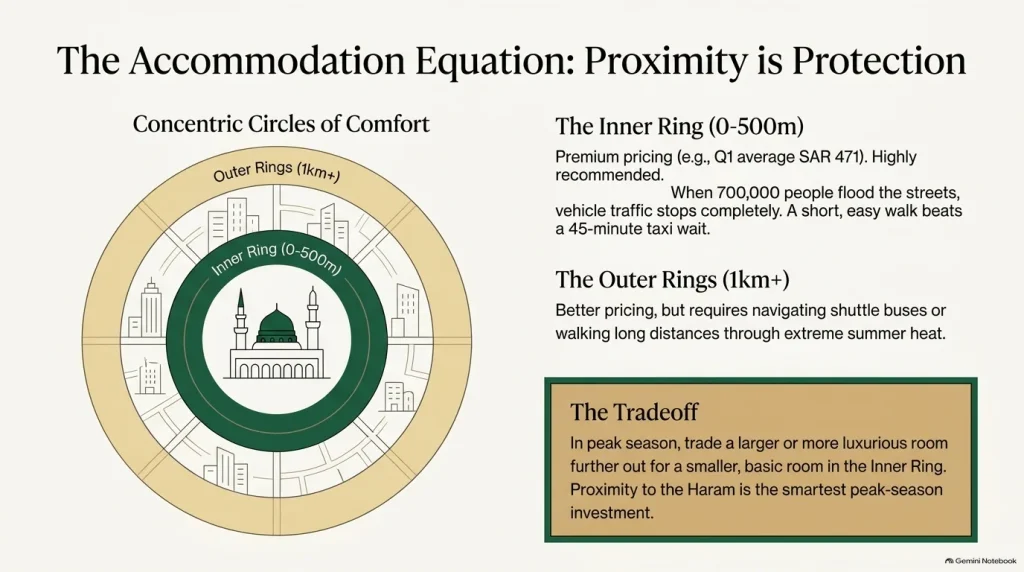
2. Stay within walking distance, even if the room is smaller
When 700,000-plus people a day are heading to the same place, traffic around the Haram slows to a crawl near prayer times. A short walk beats a long taxi wait every time. In peak season, we’d trade the bigger room for the closer hotel without thinking twice.
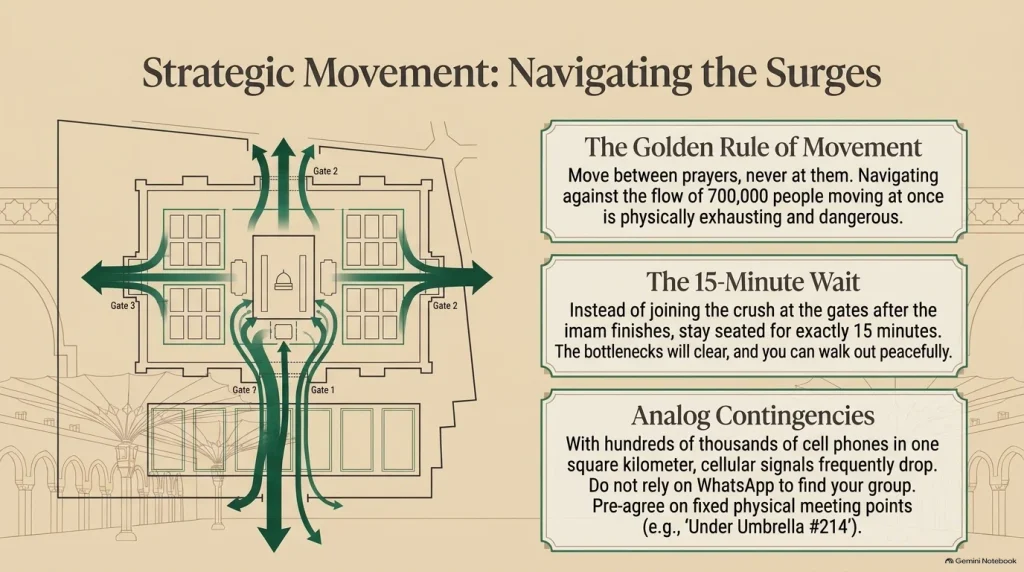
3. Move between prayers, not at them
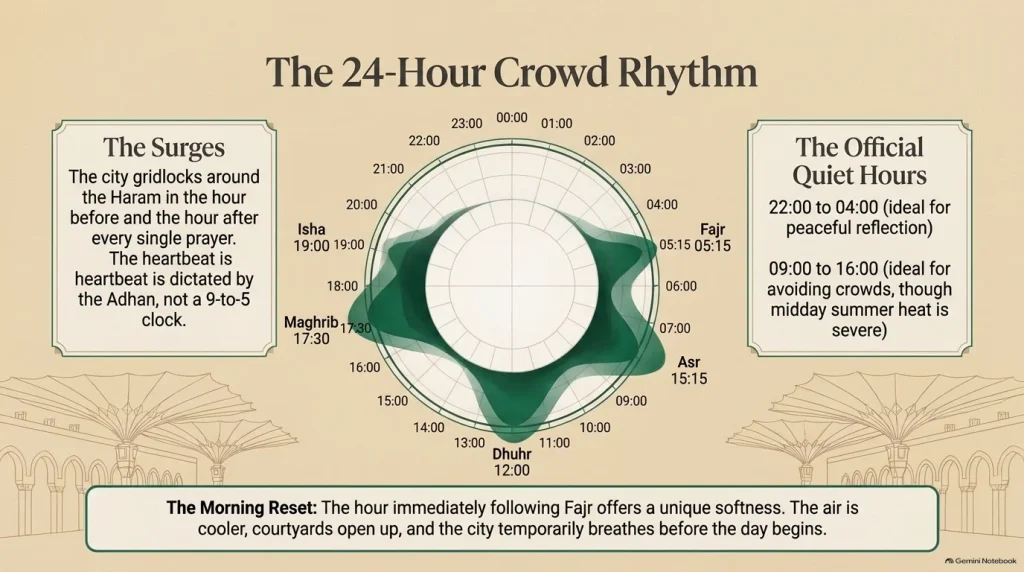
The crowd surges in the run-up to each adhan and again as everyone leaves after the salah. So arrive early and stay put, or sit for 15 minutes after the prayer with your adhkar before heading out. The gates clear, the walkways open up, and you leave in peace instead of in a crush.
4. Agree a meeting point for your group
Phones die and signal drops when this many people are in one place. Pick a fixed spot, like a numbered gate or a particular umbrella row, before you go in. It sounds small. It’s the thing that stops a busy day turning into a panicked one.
5. Eat and drink at the quiet times
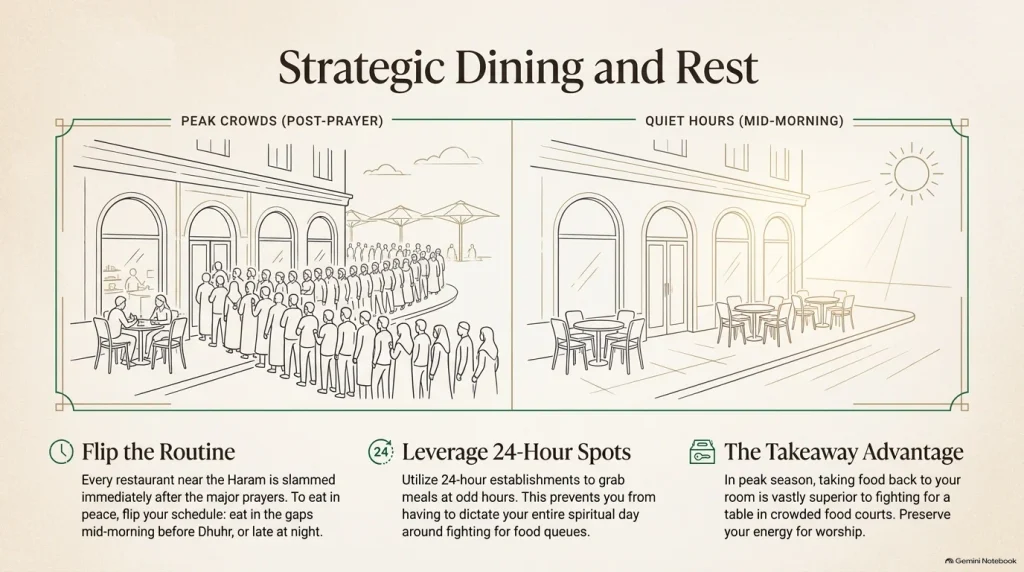
Here’s a pattern you’ll notice fast. Every café and restaurant near the Haram gets slammed right after the big prayers. So flip it. Get your karak or your meal in the gap before Dhuhr, or late at night when everyone else has sat down.
Furni is four minutes’ walk from Masjid Al Nabawi and open 24 hours, closing only during salah, so you can grab something at an odd hour without planning your whole day around it. In a hurry? Takeaway is the smart move. We’ve written about why worshippers are turning to takeaway between prayers, and it’s even truer in peak season.
6. Use the early mornings, and bring a layer
The hour after Fajr has a softness to it, even in the busiest months. The courtyards are more open and there’s room to sit with your Qur’an. But in December and January, open marble at dawn is properly cold, with lows around 12–14°C, so pack a jumper or a light jacket. Our guide to quick refreshments after Fajr in Madinah covers where to get something warm before the city wakes up.
7. Look after the people you came with
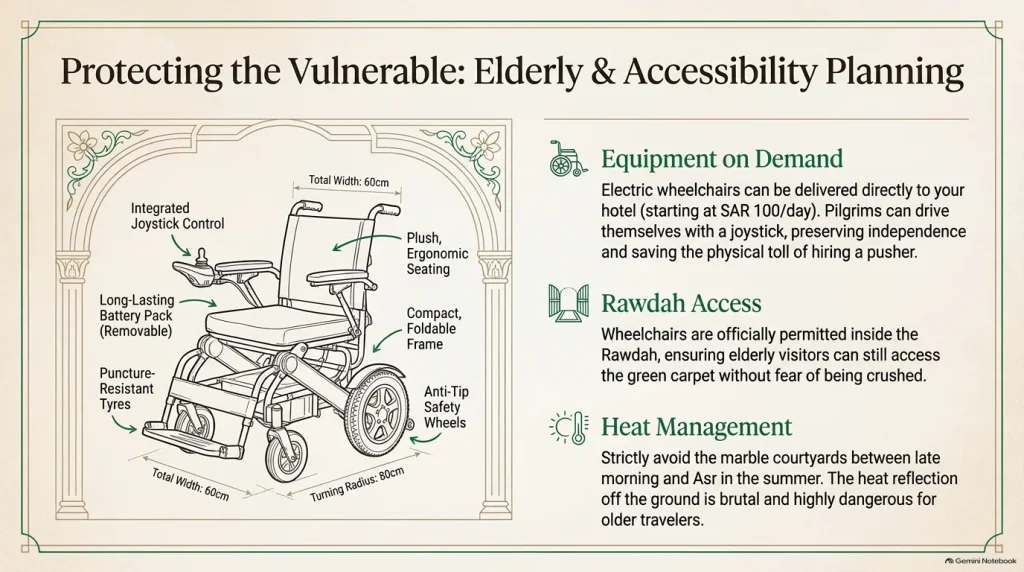
Crowds are hardest on older parents, people with mobility needs and small children. That September figure of 79,599 people helped by the mosque’s teams tells you the help is there, so ask for it. Wheelchairs are permitted for elderly visitors to the Rawdah. And build rest into the day. Nobody needs to be in the front rows for every prayer to have a meaningful trip.
8. Keep an eye on the weather
Rain in Madinah is rare, but winter storms come fast, and big crowds on wet marble is a slippery mix. A red rain alert was issued in November 2025. From November to March, check the National Center for Meteorology before you head out. We’ve put together tips for rainy days in Madinah too.

A small mindset shift that helps
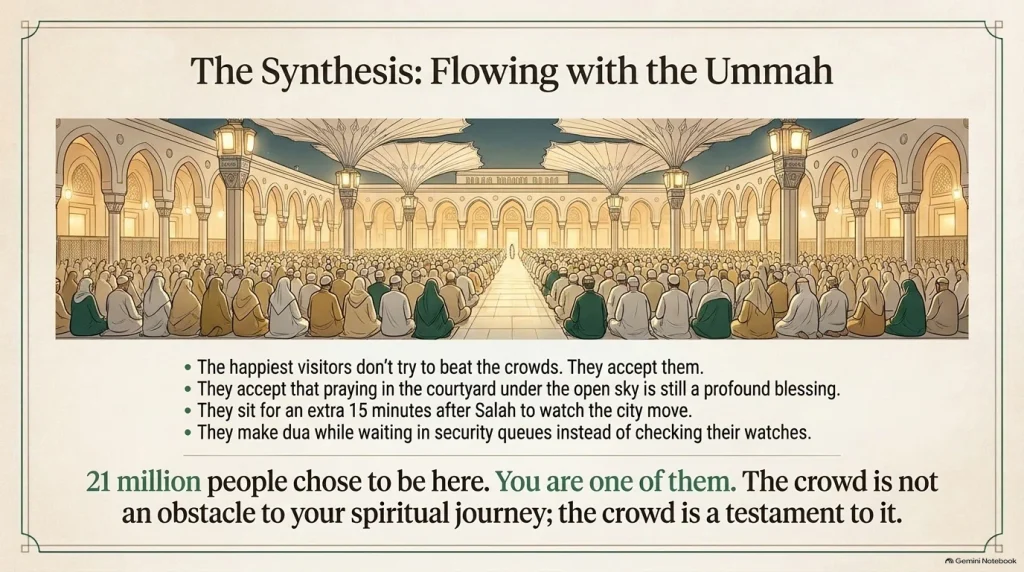
Maybe it’s just us, but the visitors who seem happiest in peak season aren’t the ones who beat the crowds. They’re the ones who stopped trying to. They accept that they’ll pray in the courtyard sometimes. They sit for an extra 15 minutes after salah. They make dua in the queue instead of checking the time.
Twenty-one million people came here in a single month. You’re one of them. Being part of that crowd is kind of the whole point.
Frequently asked questions
How many people visit Masjid Al Nabawi each month?
Masjid Al Nabawi received 21,615,977 visitors in September 2026, according to the General Authority for the Care of the Two Holy Mosques. Busier months go higher: Jumada al-Akhirah 1447 passed 23 million.
When is Ramadan 2027 in Madinah?
Ramadan 1448 is expected to begin around 8 February 2027, with Eid al-Fitr around 9 March 2027. The exact dates depend on moon sighting in Saudi Arabia.
What is the least crowded time to visit Masjid Al Nabawi?
In the year, summer (June to September) is the quietest stretch, though it’s still busy and very hot. In the day, the gaps between prayers, such as mid-morning after the post-Fajr rush and late at night, are calmer. Fridays and Ramadan nights are the busiest.
Do I need a permit to pray in the Rawdah?
Yes. Rawdah visits are booked through the Nusuk app, normally once every 365 days, with separate time slots for men and women. An instant option is available to people already near the mosque.
Is it worth visiting Madinah in summer?
It can be, if you’re healthy and on a budget. Hotels are at their cheapest, but average highs reach 43–44°C, so plan to move at night, drink water steadily and rest through the middle of the day.
Plan your peak-season visit
Book your Rawdah slot, pick a hotel you can walk from, and agree a meeting point before you go in. Then, when you need a break from the crowds, come find us at Furni, four minutes from the Haram. Have a look at our menu before you arrive, so you can order quickly and get back to what you came for.