
Getting There and Back Before Dhuhr
Masjid Quba is the first mosque built in Islam, and praying two rak’ahs there carries the reward of an Umrah.
You’ve prayed Fajr at Masjid an-Nabawi, the sky’s going pale, and someone in your group says, “Shall we do Quba this morning?” Everyone nods. Then the real question lands: can you get there, pray, and be back inside the Haram before Dhuhr without running?
Yes, easily, if you count backwards from Dhuhr instead of forwards from breakfast. That one change is most of this guide.
- Distance: Masjid Quba is about 3.5 km south-west of Masjid an-Nabawi. The pedestrian Quba Walk covering most of it is about 3 km.
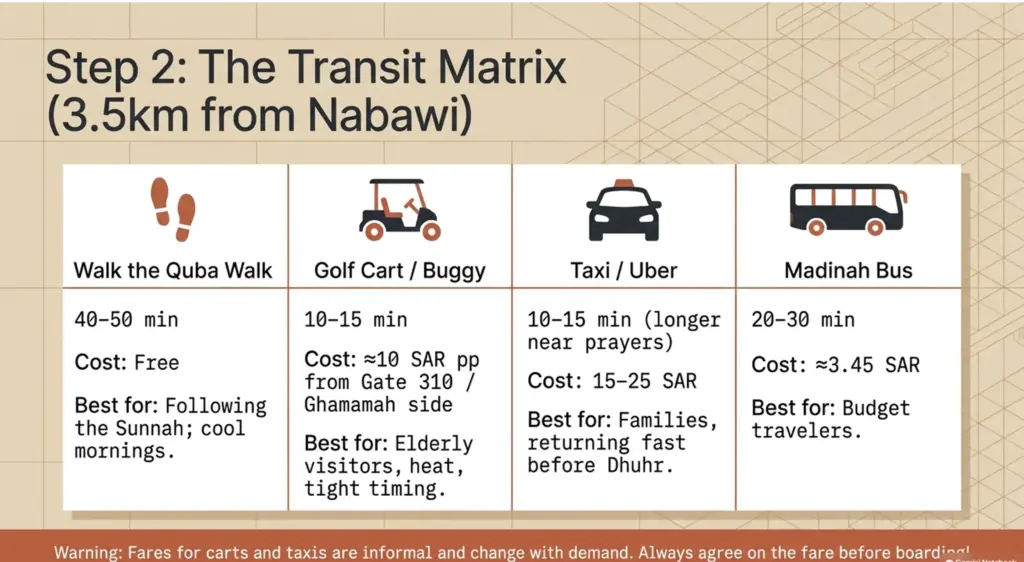
- Getting there: about 40–50 min on foot, 10–15 min by golf cart (around 10 SAR from the Gate 310 side), or 10–15 min by taxi outside rush hour.
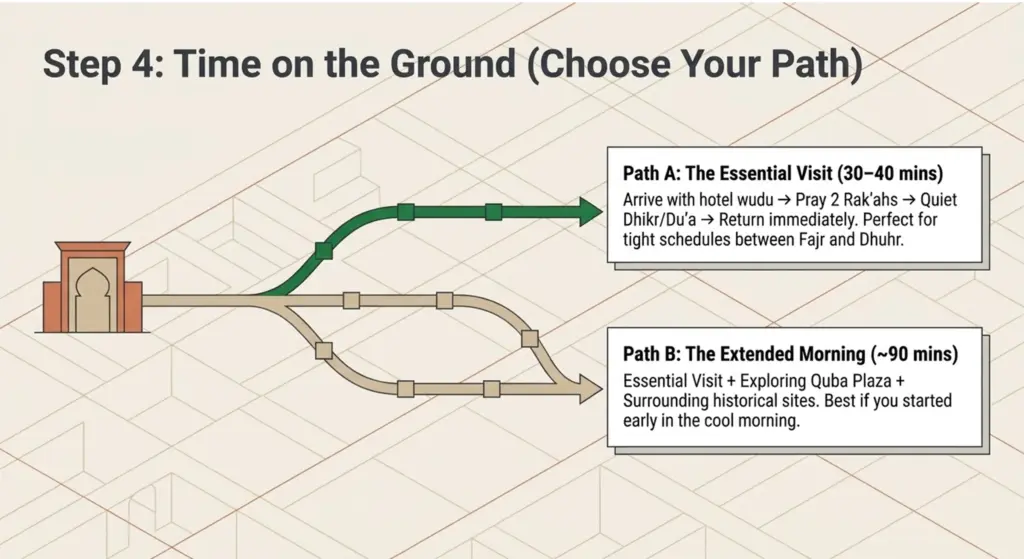
- How long to spend: 30–40 minutes for wudu at your hotel, two rak’ahs and a quiet moment. Allow 90 minutes if you add Masjid al-Jumu’ah and the Quba plaza.
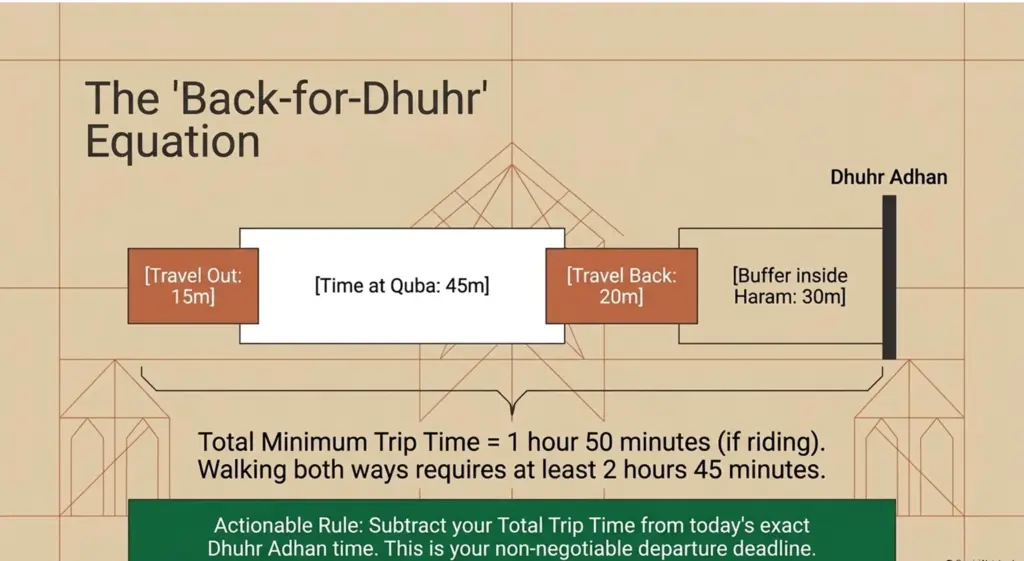
- Back for Dhuhr: if you walk both ways, leave Masjid an-Nabawi at least 2 h 45 min before Dhuhr. Riding both ways cuts that to about 1 h 50 min. Use the planner below for your own numbers.
Masjid Quba is about 3 to 3.5 km south of Masjid an-Nabawi. Walking takes roughly 35 to 50 minutes along the Quba walkway, and a buggy or taxi takes a few minutes plus waiting. Make wudu at your hotel, pray two rak’ahs, and allow 30 to 45 minutes at the mosque. If you walk both ways, leave the Haram about 2 hours 45 minutes before Dhuhr. Ride both ways and that drops to about 1 hour 50.
We’re Furni, a café four minutes from Gate 329 on the north side of Masjid an-Nabawi. Quba is the trip most of our guests make at some point in their stay, so here’s everything you need in one place.
Why visit Masjid Quba?
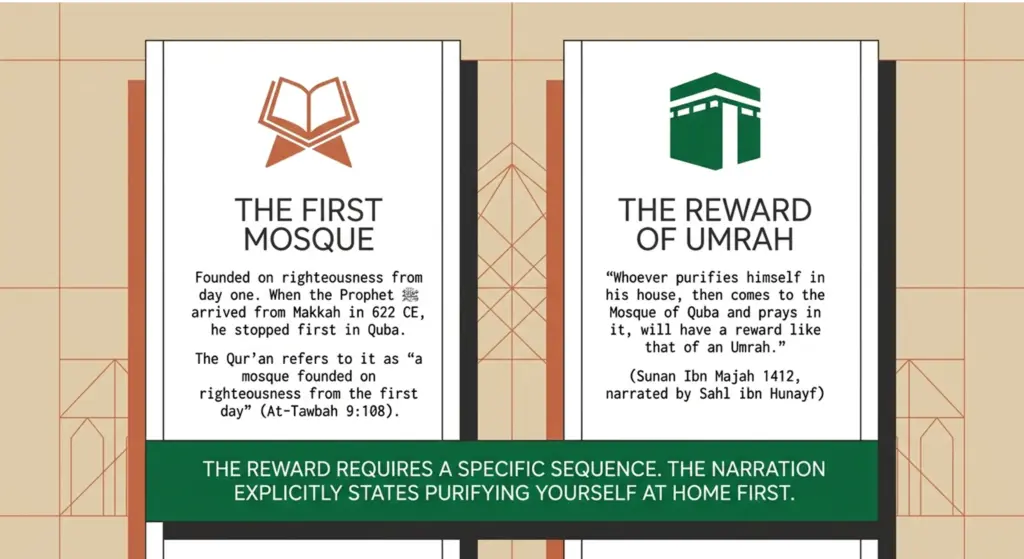
Masjid Quba is the first mosque built in Islam. The Prophet ﷺ and his companions built it in 622 CE, when he reached Quba on the southern edge of Madinah during the Hijrah, before entering the city itself (Saudipedia). Many scholars hold that it’s the mosque the Qur’an describes as “founded on righteousness from the first day” (At-Tawbah 9:108).
Two narrations are why almost every pilgrim makes the trip:
- The reward of an Umrah. The Prophet ﷺ said: “Whoever purifies himself in his house, then comes to the Quba’ Mosque and offers one prayer therein, will have a reward like that for ‘Umrah” (Sunan Ibn Majah 1412, narrated by Sahl ibn Hunaif, graded hasan).
- A weekly habit. Ibn ‘Umar reported that the Prophet ﷺ used to go to Quba every Saturday, sometimes walking and sometimes riding (Sahih al-Bukhari 1193).
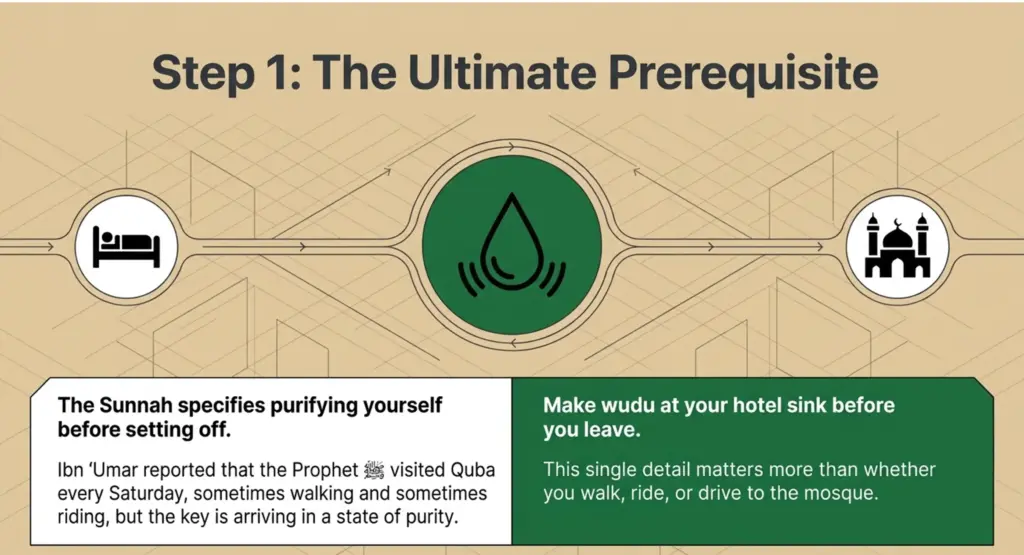
Look closely at the first one. It says purify yourself in your house, then come. So make wudu at your hotel before you set off. People argue about whether walking or riding is better, but this is the detail the hadith actually spells out, and it’s the one most people skip because there are wudu areas at the mosque.
How far is Masjid Quba from Masjid Nabawi?
About 3 to 3.5 km, depending on which gate you leave from. Saudipedia describes the Quba Front pathway as roughly 3 km from Quba Mosque to the area around the Prophet’s Mosque, and Bayut’s guide to the Quba walkway puts the walk at 3 to 3.5 km.
That’s close enough to walk, and far enough that the walk back at 11am in May will hurt. Keep that in mind.
Masjid Nabawi to Masjid Quba: walk, buggy, taxi or bus
There are four realistic ways to go. Choose by the time of day and who’s with you, not just by price.
| Option | Time | Typical cost | Best for |
|---|---|---|---|
| Walk the Quba walkway | 35–50 min | Free | Cool mornings, following the Sunnah of walking |
| Buggy / golf cart | About 5 min riding, plus any queue | Around 10 SAR per person | Older parents, hot days, tight timing |
| Taxi or ride-hailing app | 10–15 min, longer near prayer times | Varies with demand; agree it first | Families, the trip back before Dhuhr |
| Madinah Bus | Allow 30 min with waiting | 3.45 SAR on most routes | Budget travellers who don’t mind checking timetables |
Can you walk to Masjid Quba from Masjid Nabawi?
Yes, and if the weather allows, it’s the nicest way to go. The Quba walkway (part of the Quba Front project) is a paved, lit pedestrian route with palm trees, benches and shaded rest spots along the way (Visit Madinah).
- Leave the Haram from the south-west side. Most walkers start near Gates 309 and 310, close to Masjid al-Ghamamah. Our guide to the Masjid Nabawi gates shows which courtyard is which if you’re not sure where you are.
- Head south-west past the hotels and pick up the walkway.
- Stay on it. It ends at the plaza in front of Quba Mosque.
At an easy pace, plan on 35 to 50 minutes. With children, elderly parents or a crowd, call it an hour. And if you’re walking both ways, that’s around 7 km before Dhuhr, so carry water. More than you think.
Golf cart or buggy to Quba
Buggies run along the walkway. Bayut puts the fare at about 10 SAR per person for a ride of roughly five minutes. Prices are informal and can change with the season, so confirm before you sit down, and have small notes ready. For the return, queues build up at the Quba end just before prayer times. Don’t leave it to the last minute.
Taxi from Masjid Nabawi to Masjid Quba
The drive is short. The traffic isn’t, at least around the Haram before Dhuhr and after Asr. Ride-hailing apps show a price before you book, which saves the haggling. With a street taxi, agree the fare before you get in. If you’re relying on a taxi to get back for Dhuhr, leave Quba a bit earlier than feels necessary.
Bus to Masjid Quba
The government-run Madinah Bus network costs 3.45 SAR on most routes, paid on the bus or through the official app. KSA Expats lists Route 401 (Al-Aliyah to the Islamic University) as the one serving Quba Mosque, running 6am to 10pm. That information dates from January 2025, so check the route at the stop or in the app before you plan around it. There’s also a paid hop-on hop-off tour bus that stops at Quba.
When should you leave so you’re back for Dhuhr?
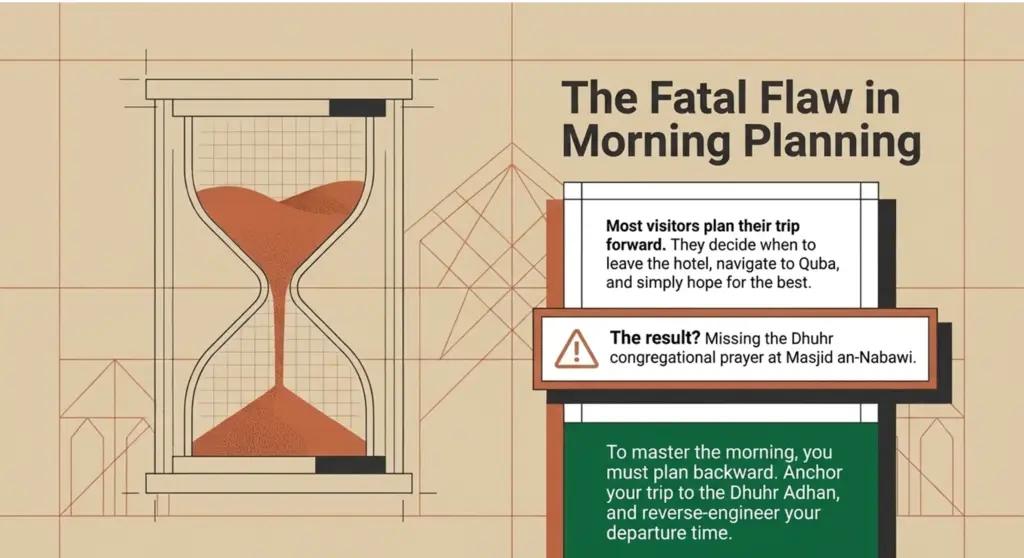
Most people get the order wrong. They pick a time to leave the hotel, then check Dhuhr, then panic. Start with Dhuhr instead and subtract.
Here’s the sum: travel there + time at Quba + travel back + time to get inside the Haram before the adhan. On a normal day, 30 minutes is a sensible buffer for getting through the doors and finding a spot. On a Friday or in peak season, make it 60.
| Your plan | There | At Quba | Back | Buffer | Leave this long before Dhuhr |
|---|---|---|---|---|---|
| Ride both ways, pray and go | 15 min | 30 min | 20 min | 30 min | 1 h 35 min |
| Ride both ways, unhurried | 15 min | 45 min | 20 min | 30 min | 1 h 50 min |
| Walk there, ride back | 45 min | 45 min | 20 min | 30 min | 2 h 20 min |
| Walk both ways | 45 min | 45 min | 45 min | 30 min | 2 h 45 min |
| Walk there, add Masjid al-Jumu’ah, ride back | 45 min | 90 min | 20 min | 30 min | 3 h 05 min |
Worked example: say Dhuhr is at 12:08 and you want to walk there and ride back. Take off 2 hours 20 minutes and you leave at 9:48. You’d reach Quba around 10:33, leave by 11:18, and be inside the Haram by 11:38. On a Friday, add another 30 minutes to the front.
Dhuhr shifts through the year, so check today’s time in the official Haram timetable or your prayer app before you do the sum. The “back” times above are padded a little because taxis are slower near prayer times. Peak-season crowds can stretch everything.
If we had to recommend one plan, it’d be walk there, ride back. You get the walk while it’s cool and you’re fresh, and you don’t have to rely on your legs (or the midday sun) to get you back on time.
How long should you spend at Masjid Quba?
The worship itself is short. How long you stay depends on what else you want from the morning.
30 to 45 minutes: the essential visit
Arrive with wudu from your hotel, pray two rak’ahs, then sit for some dhikr and du’a. That’s the visit the hadith describes, and it fits easily between Fajr and Dhuhr or around a group schedule. It’s what most ziyarat guides allow for too.
About 90 minutes: Quba and its neighbourhood
After praying, walk about 900 m north to Masjid al-Jumu’ah, which marks where the first Friday prayer in Madinah is reported to have been held. On the way back, browse the stalls on the Quba plaza.
Half a morning: the slow version
Walk to Quba once the sun is up, pray, visit Masjid al-Jumu’ah, rest in the shade, then take a buggy or taxi back with time for breakfast before Dhuhr. Door to door, plan on three to four hours. Do it on a Saturday and you’re also following the Prophet’s ﷺ weekly practice.
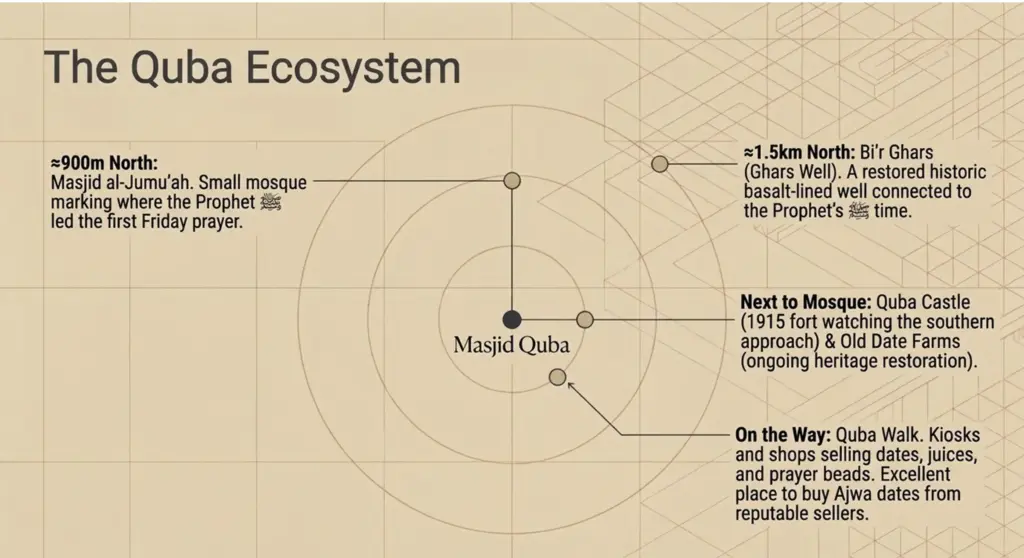
What’s around Quba Mosque?
Most guides stop at the mosque door, which is a shame, because the area around it has plenty of history of its own.
- Masjid al-Jumu’ah (about 900 m north). A small mosque linked to the first Jumu’ah prayer in Madinah. It’s the easiest add-on on foot (Saudipedia).
- Ghars Well (about 1.5 km north-east). One of the historic wells of Madinah, dug more than fifteen centuries ago according to Saudipedia.
- Quba Castle. A small fort built in 1915 to watch over the southern approach to the city.
- The walkway souq. Stalls along the route sell prayer beads, perfume, abayas, dates and juice, and there are well-known fast-food chains near the walkway too. If you’re buying dates, read our guide to buying real Ajwa dates in Madinah first.
- The old palm gardens. Quba was farmland long before it was a suburb. The King Salman expansion plan includes developing or restoring around 57 nearby sites, including wells, farms and orchards (Arab News).
The mosque today, and the building work
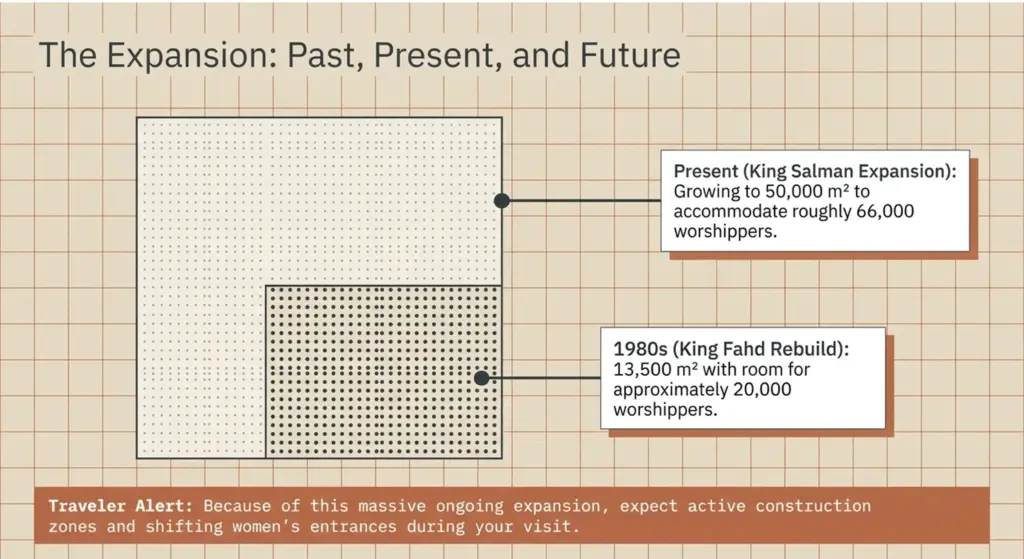
The current building comes from King Fahd’s expansion, inaugurated in 1987, which took the site from 1,600 m² to 13,500 m² and added four 47 m minarets (Saudipedia). It holds around 20,000 worshippers. In 2022, Crown Prince Mohammed bin Salman announced the King Salman expansion, which aims for 50,000 m² and room for about 66,000 worshippers (Arab News). So expect construction hoarding and the odd moved entrance while that work continues. Sisters especially should check the women’s entrance on arrival instead of assuming it’s where it was last time.
Best time of day to visit Masjid Quba
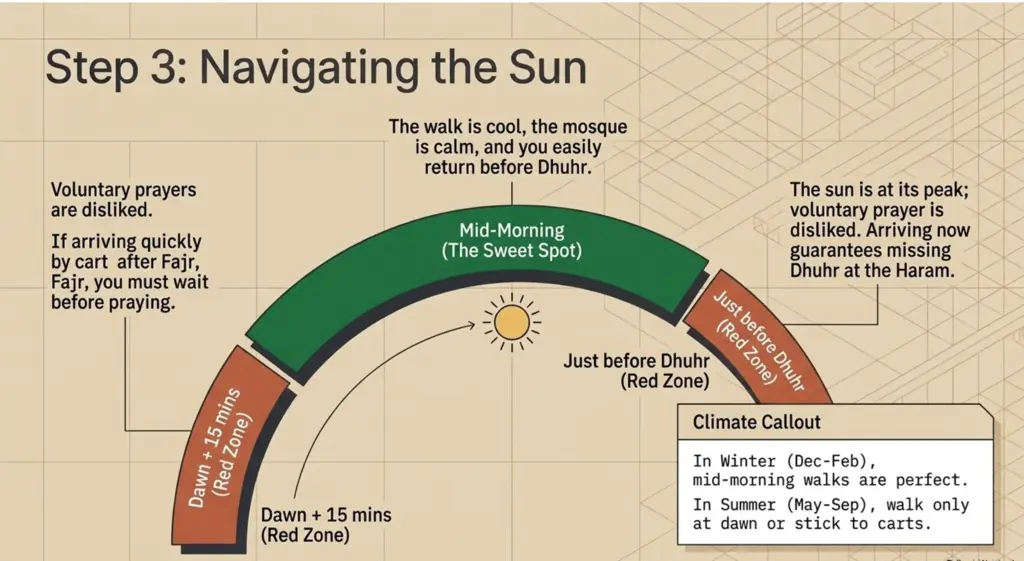
Early morning, once the sun is properly up, is the sweet spot. The walk is cool, the mosque is calm, and you’re back at the Haram with time to spare. A few timing details most guides skip:
- Straight after Fajr. Voluntary prayer is disliked from Fajr until the sun has risen a little, roughly 15 to 20 minutes after sunrise. If you walk straight after Fajr, you’ll probably arrive at about the right time. If you take a buggy, you may need to wait at Quba before praying.
- Just before Dhuhr. The few minutes when the sun is at its highest are also a disliked time for voluntary prayer. Turning up at Quba “just before Dhuhr” is the worst plan of all: you can’t pray your two rak’ahs on arrival, and you’ve missed Dhuhr in the Haram.
- Fridays. Jumu’ah fills Masjid an-Nabawi early. If you want Jumu’ah there, do Quba on another day, or use the 60-minute buffer. Our live crowd updates give you a feel for how busy the Haram is.
- Winter versus summer. From December to February, a mid-morning walk is pleasant (more in our piece on Madinah in winter). In the summer months, walk at dawn or after Asr, or take a buggy.
Is Masjid Quba the same as Masjid Qiblatain?
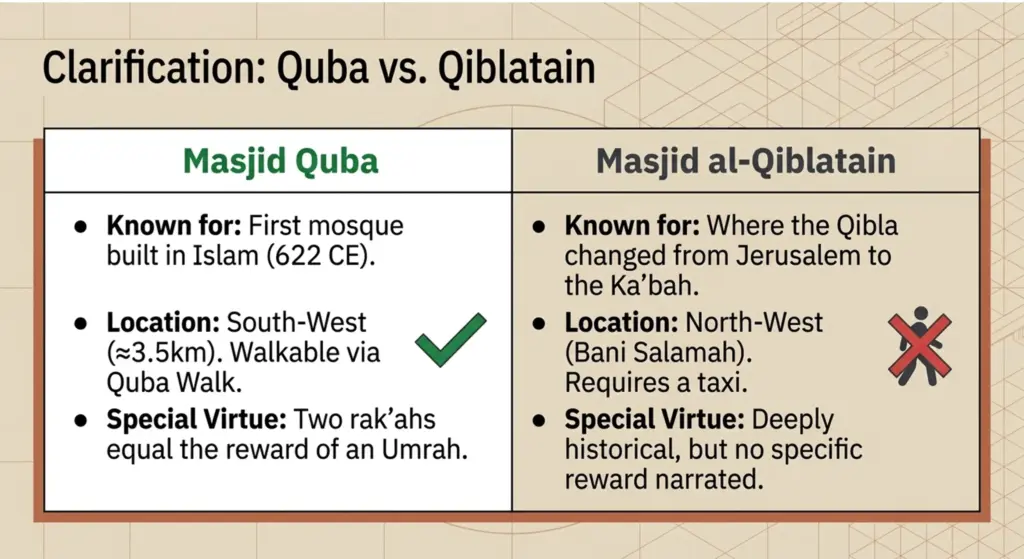
No. They’re two different mosques in different parts of Madinah. People mix them up because both are on the standard ziyarat route.
| Masjid Quba | Masjid al-Qiblatain | |
|---|---|---|
| Known for | First mosque built in Islam (622 CE) | Where the qibla changed from Jerusalem to the Ka’bah |
| Location | About 3–3.5 km south of Masjid an-Nabawi | About 4 km north-west of Masjid an-Nabawi |
| Special reward | Prayer there carries the reward of an Umrah (Ibn Majah) | Historic; no specific reward narrated |
| Walkable from the Haram? | Yes, via the Quba walkway | Not really; take a taxi or tour |
Because they’re on opposite sides of the city, pair them by taxi or as part of a ziyarat tour. Don’t try to walk between them.
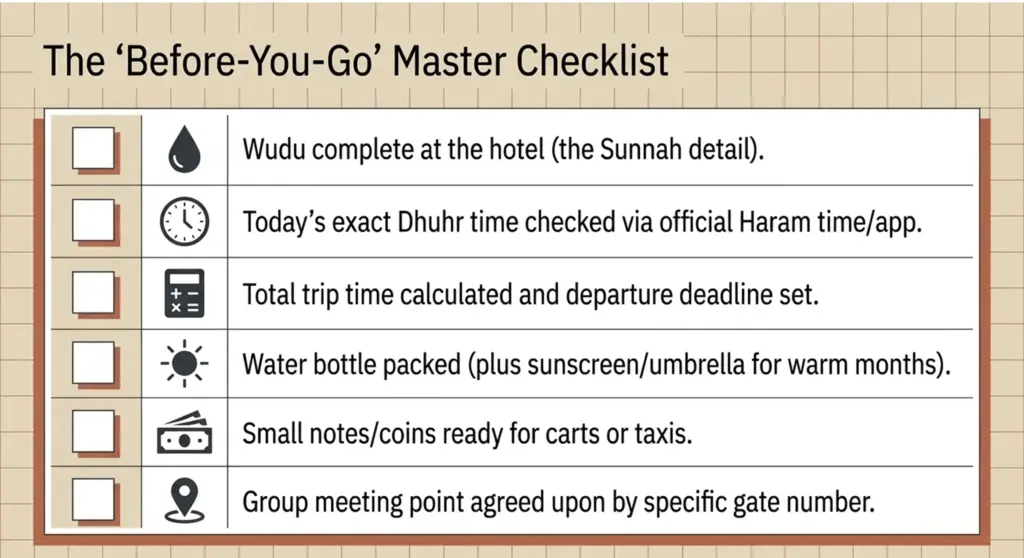
Before-you-go checklist
- Wudu made at your hotel
- Today’s Dhuhr time checked in the official Haram timetable or your prayer app
- Leave time worked out from the table above
- Water, plus sunscreen or an umbrella in the warmer months
- Comfortable shoes and a bag to carry them inside the mosque
- Small notes or coins for a buggy or taxi
- A meeting point agreed with your group, by gate number
- Sisters: women’s entrance checked on arrival, because entrances move during the building work
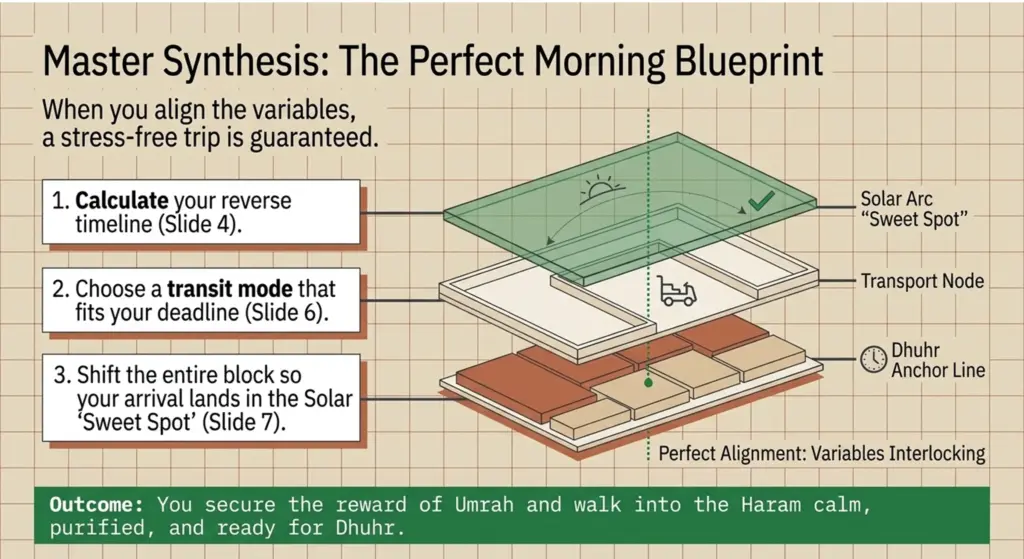
Back at the Haram with time to spare?
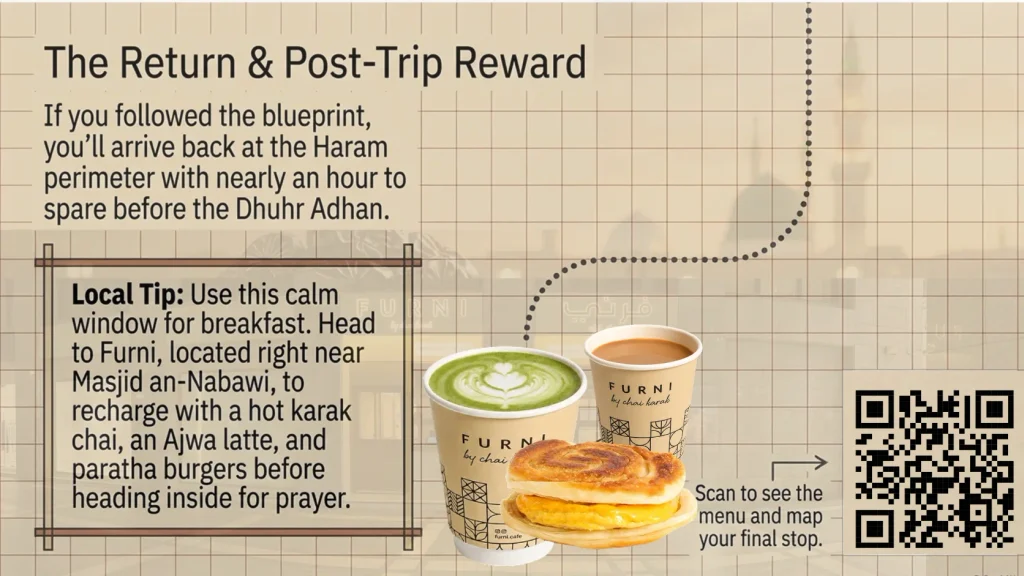
If you set off early, you might be back with an hour before Dhuhr. That’s a good window for breakfast, and you’ll have earned it after a 7 km round trip. Our post on planning meals around prayer times explains how to fit food in without cutting it fine, and if you want ideas, here’s our round-up of breakfast near Masjid Nabawi.
At Furni we’re four minutes from Gate 329 and open around the clock. A hot karak chai or an Ajwa latte after the walk is a pretty good way to end a Quba morning. Have a look at our menu or see how to find us.
First trip to the city? Start with our first time in Madinah guide.
Masjid Quba FAQs
What is the reward for praying at Masjid Quba?
According to Sunan Ibn Majah 1412, whoever purifies himself at home and then prays at Masjid Quba gets a reward like that of an Umrah. Two rak’ahs is the customary prayer.
What is the best day to visit Masjid Quba?
Any day is fine. Saturday follows the Prophet’s ﷺ own habit, as he visited Quba every Saturday (Sahih al-Bukhari 1193). Avoid Friday mornings if you want Jumu’ah at Masjid an-Nabawi.
Is Masjid Quba open all day?
Yes. It’s open for prayer throughout the day. The times that matter are the disliked times for voluntary prayer, just after sunrise and just before Dhuhr, and your own Dhuhr deadline.
Is Masjid Quba in Makkah?
No. Masjid Quba is in Madinah, south of Masjid an-Nabawi. It sometimes gets searched with “Makkah” in the name, but the Quba Mosque of the hadith is in Madinah.
Which gate of Masjid Nabawi is closest to the Quba walkway?
The south-west side, around Gates 309 and 310 near Masjid al-Ghamamah. That’s where most walkers start, and where the buggies tend to gather.